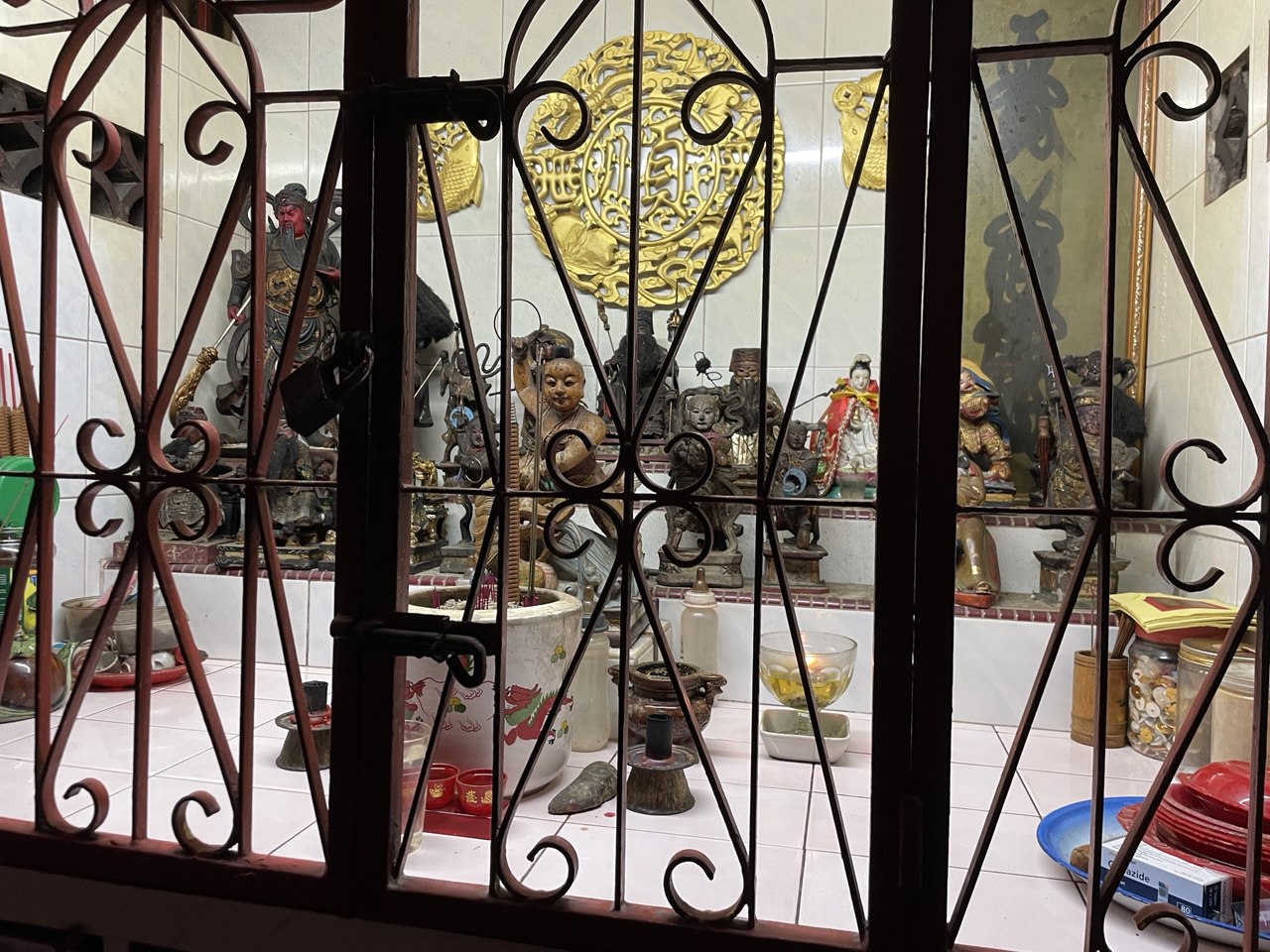
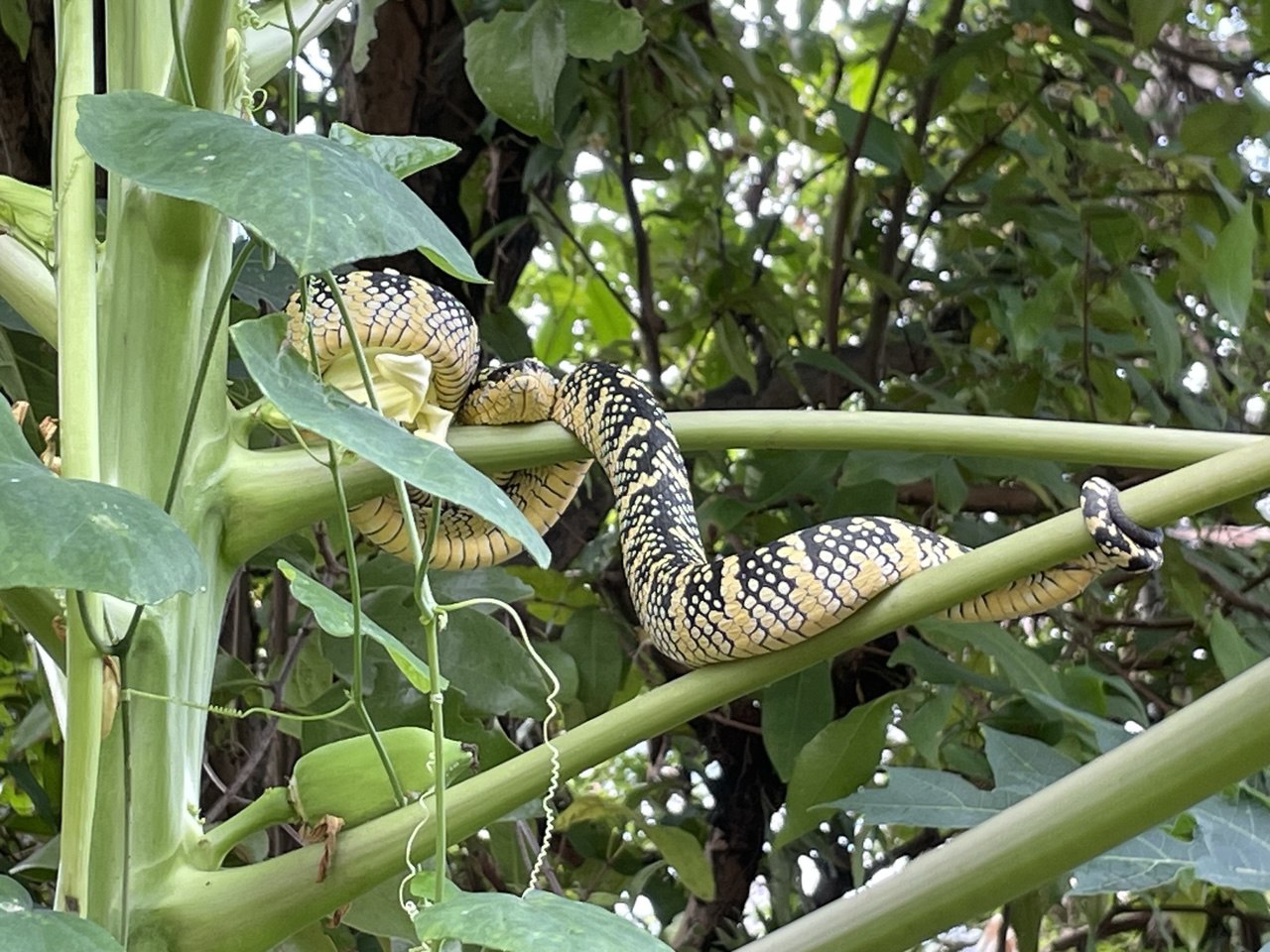
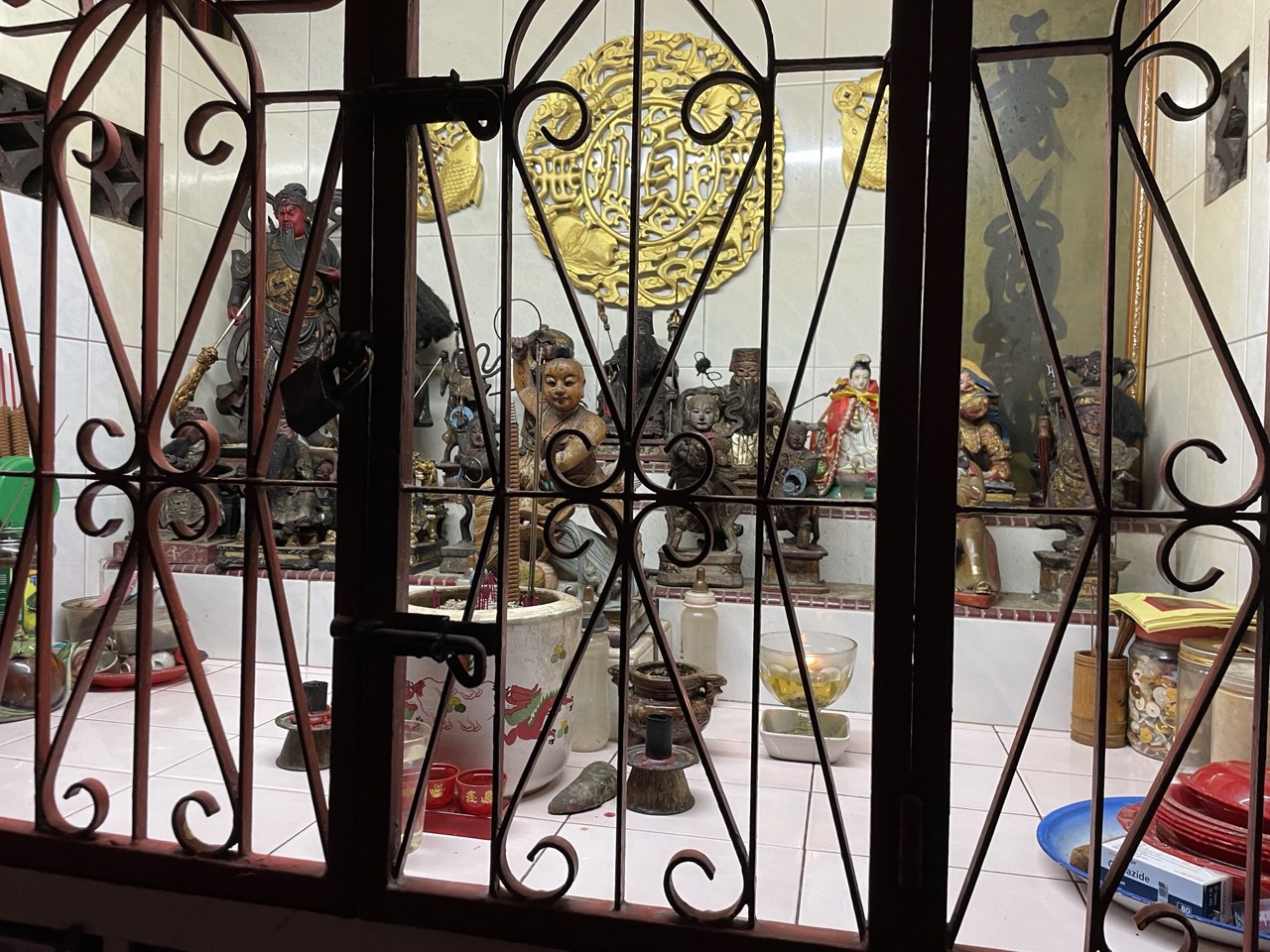
I don’t think I’ve had time to sit down and write since November ended, which is in some ways a pathetic excuse, but here you go—now it will be as if you were with me. my fellowship at the arts house has ended and I haven’t even had time to process it. but we went out with a bang–they schlepped me over to penang for the annual literary fest. george town was quite unexpectedly beautiful—I don’t think I’ve been there before—and I really liked all the temples and incense that was happening. I liked the stray dogs and I liked the hanging out under a garish painting next to some writer you’ve only met in passing in another country years ago, someone you’ve heard more about than talked to. I cut my finger on a rusty lock trying to close the bathroom door. and I liked all the snakes at the snake temple but I didn’t like that they were being paraded around as a means to get tourist dollars from novelty photos. it is what it is. if I had more resources I would love to start a snake sanctuary for these pit vipers because I love them. at the temple a woman with eyes that could look in different directions showed me all the hiding places and asked if I knew about Guanyinma. she said tourists shouldn’t come, that it was too noisy, that worship should be in silence. I agreed in my broken but phonetically accurate (she said!) mandarin.

Notes from George Town Literary Festival (28-30 Nov)—A smattering of panels
Panel: She Who Remembers, She Who Rewrites (Mod. by Bernice Chauly; Ramayda Akmal, Lize Spit)
This panel posits to look at a village and ask, what happens when a woman goes back? Chauly asked important and incisive questions around the themes of ‘memory not as archive but as rebellion’ and memory as a form of resistance and agency’. One of the questions that made me think the most was her putting to the authors, who both write about quite traumatic events, the question, ‘How do you preserve the dignity of the characters?’
Answers to that question revolved around protecting the agency of the reader and the language—that is, letting the character construct themselves with language and literacy. Spit stated that whatever happens to the character, the most important thing, for her, is to make sure that the character is never alone. Akmal had a different take—she sets boundaries to not project herself completely into one character.
There was also the question of navigating the ethics of harm—Spit also says of her first novel, The Melting, that she imagines ‘people who read it are harmed in some way’. There is a certain ideology present, that I identify with, against ‘aesthetic’ literature, fuelled in part by anger at hypocrisy. It is here that I conclude books as ‘tools of immorality’ are often used as dangerous weapons against existing social authorities.
On the relationship between reality and literature, Ramayda says,’to keep distance is the most difficult thing; to put aspects that you don’t like into a character. Fiction has the ability to refract and expand reality, especially in situations where it’s difficult to express certain ideas.’
In the end, being able to say ‘I wrote it for myself’ is the ultimate first step: everything starts with writing the book you want to read.
For Spit, creating a fleshed-out character is about ‘disguising your beating heart’; the character starts from a deep need that is in you—and you remain in company with it for the months you are writing the book.
Panel: ‘Intimacies & Inheritances’ (Mod. by Sharon Bakar; Lize Spit, Ratih Kumala, Cyntha Hariadi)
Composite characters leading to fictional characters based off of real people
Questions about obligations to honesty—and bringing up the concept of autofiction as a women’s genre. Spit, on how language envelops and ingests the incident of trauma, describes it as ‘language is the white blood cell’ in her latest book. Hariadi mentions childbearing as both violence paramount enacted upon the female body and its entrenchment, dissolution and rendering invisible by society, which views childbirth as a divine miracle, both ways to dehumanise one’s personhood. Hariadi—‘When you’re taken from you, who will be you?’
Harm from a nationalistic and societal perspective is also described when Kumala says ‘I never thought I could be hurt by a country, especially not my own.’ And goes on to describe that perhaps the healing power of literature rests in coping mechanisms such as humour—something seen in Indonesia’s history, as well as the debut poetry of Shivram Gopinath, who has newly launched his book, Dey, at both the Singapore Writers Festival and George Town Literary Festival. The speakers also articulate that their reasons for writing from rage are often because they write for a community. There is an importance in distinguishing between privilege and social mobility between members of what seems to be the same community.
Panel: ‘Poetry, Performance, Resistance’. (Mod. by Dipika Chatterjee; Bernice Chauly, paul catafago, Shivram Gopinath).
This panel asked questions about whose work taught you to resist—Chauly states that it’s not a single person’s work, but in actual fact a practice of reading every day. catafago, quoting Etel Adnan, says that poetry is inherently political because it involves telling a truth. And that the thing about using profanity in poetry, upon reading a poem called ‘Get The Fuck Out Of Gaza’, is that “the world is profane. There’s nothing more profane than a child dying because it doesn’t have formula, or is having its head blown off in a bombed hospital. The genocide is more profane than the word ‘fuck’.”
Panel: ‘Ideas, Power & The Nation’. (Mod. Sharaad Kuttan; Terence Gomez, Ooi Kee Beng)
Panel asks about the role of the public intellectual and academic, and how in modern times we have abdicated with the role of the academic. The conversation revolves around making academic findings accessible to others (such as in the qualitative method of writing, as opposed to quantitative, which comprises numbers and figures that can only be parsed by other academics. Who, then, are we writing for? To Gomez, universities have lost their roles in society. Ooi describes himself as a disappointed journalist, then a disappointed citizen, then a disappointed academic. Creating Penang Journal was, for Gomez, an act of encouraging public intellectualism. The attitude taken towards writing and creating a body of work is ‘as a map of your own development’—much as the body develops, so too do one’s ideas. Ooi: ‘I think a good writer lives in his time’.
They also touch on the problem of ‘the young don’t read’, and that the young are unaware of their own history. Combined with the tendency of states to whitewash and impugn the sanctity and veracity of their own stories, it’s inevitable that they will collectively create an intended miasma of amnesia. Even if Gen Z wants change, apparently, no one has any idea of the kind of change they want.
Against the idea of writing merely to please the self, Gomez intentionally publishes with large publishers such as Penguin as he feels the public he writes for is more than just ‘Malaysia’. He goes on to state that even though Malaysian audiences found his content in Misgovernance ‘depressing’, he had actually intended the opposite: for them to be galvanised to action.
Ooi describes Malaysia as a ‘reluctant nation’, with the other speakers chiming in that we ‘muddle along’. In this way there are parallels and differences with Singapore; though we would be hard-pressed to describe any of what we do as ‘muddling along’, there is a certain reluctance and artificiality in the way our nation-building is set up; the self-affected un-messiness speaks to a larger interplay of contradictions at hand that governance wants to, or must, ignore, in other to put forth certain neat ideals of social engineering.
The last point of interest was that of Gomez’s: ‘Intellectualism doesn’t have to be limited to books any more’, stating that his students might take the core message of what he’s saying and ‘go viral’ with it on TikTok or Twitter. But I hesitate to take this fully at face value: disseminating an idea through other mediums is well and good, but I wonder if the rich layers of discourse may be somewhat less robust on other platforms? Certainly I am not opposed to the idea—I have seen many a philosophical argument play out on 4chan—but I wonder if short-form video is killing the ability to engage with a train of thought for any protracted period of time.
The audience leaves us with two excellent questions— “Is sponsoring public intellectuals to blame for their being unable to practice austerity?” and “Is there a greater need for intellectuals to push back against intellectual dishonesty?”
Panel: Echoes of A Homeland (Mod. Tong Veng Wye; Nur Masalha, Ahmed Masoud, paul catafago)
This panel of Palestinian writers puts forth that the story of Palestine is a global issue. How one manages and negotiates crisis, genocides and violence is a global issue. The moderator described Masoud as ‘identifying always as Palestine without apology’, but the big question is, why should he be assumed to want to be apologetic? The speakers also described a Malaysian writer as being ‘Palestinian by will’ (as opposed to Palestinian by birth)—how our words can speak solidarity to each other across continents. The irony of Nur Masalha being from Nazareth, a little town most commonly known as Jesus’ birthplace, a non-violent, radical figure who is for the sex workers and the poor, whose reincarnations across the world in right-wing movements have recreated him as a racist, misogynistic white guy. The speakers were also asked about Mahmoud Darwish, who has famously said that he is unable to write about the big questions like time, love and death, when the immediate urgency of the socio-political reality of Gaza looms overhead. Masoud’s response to this describes himself writing about love under the genocide. He tells a story about a woman, clutching a love note, as the last thing she saw before she died—not a holy tract or a manifesto—as much an answer as any is to the question, ‘Do you have to write about this right now? Is this important right now?” as much as the sentiment of “This is exactly what we need.” What’s there left to fight for but love? catafago concludes the panel by saying that every poem he writes is a Palestinian poem, by virtue of the fact of his birth, and what’s important is focusing on the censorship and erasure of narrative truths.
Book launch: Dey, by Shivram Gopinath. (Mod. Dipika Mukherjee)
Finally, I was delighted to catch Shivram Gopinath’s Penang edition of the debut launch of Dey (being unable to in my own country, through the fault of none but my shitty schedule). Mukherjee asked a question about minority memory as a form of resistance, especially in a country with a history of amnesia. A reminder for other people not to forget. For Gopinath, it’s a slice of truth in a reality where forgetting is sometimes enforced upon you. He sees writing from memory not as a solution, but a reminder not to forget. In Dey, there exist conflicting voices, chief amongst them the way South Asian migrant workers are perceived in Singapore. A migrant worker’s labour is invisible until he rappels into a storm drain to rescue a cat, upon which he is a kind hero. Other times, he is all manner of unutterable stereotypes, looked upon with apathy and disdain at best and malice at worst. The irony of unironic headlines, documented and remixed in Gopinath’s work, being called ‘foreign workers with a big heart’, oddly reminiscent of the trope of the ‘hooker with a heart of gold’ is juxtaposed with the discourse on the Little India ‘riots’—which, as Gopinath says, were not so much riots but spontaneous combustions of anger in a backdrop of continuing prejudice in a country that is built off of the backbone of their labour. Touching on craft, Gopinath also mentioned the influence that taking a competitive approach in the guise of slam poetry had on his work—something that lent him the ability to wield the unconventional and breaking out of the expected to great success. Most of all, the Tamil language and culture are key to Dey, which features it beautifully and perhaps disruptively to an Anglophone audience—yet Gopinath also mentions that it is not viewed kindly as “Tamil” “poetry” by readers of Tamil poetry, another contradiction inherent in Gopinath’s work.
I still won’t be able to sit down until day after tomorrow, so come to the show:
HOT IMPROVISED EROTICA AT RIOT!!!
13 DEC SATYRDAY, 8PM, HARD ROCK CAFE!!!
TICKETS HERE: riotdragshow.com

